


Did You Know the Car Owner Can Be Sued, Not Just the Driver?
Most people only know to go after the driver. In Florida, you can often go after the owner too, and their coverage can be much larger.
Florida Vicarious Liability and the Dangerous Instrumentality Doctrine: Who’s Really Responsible in Car Accidents?
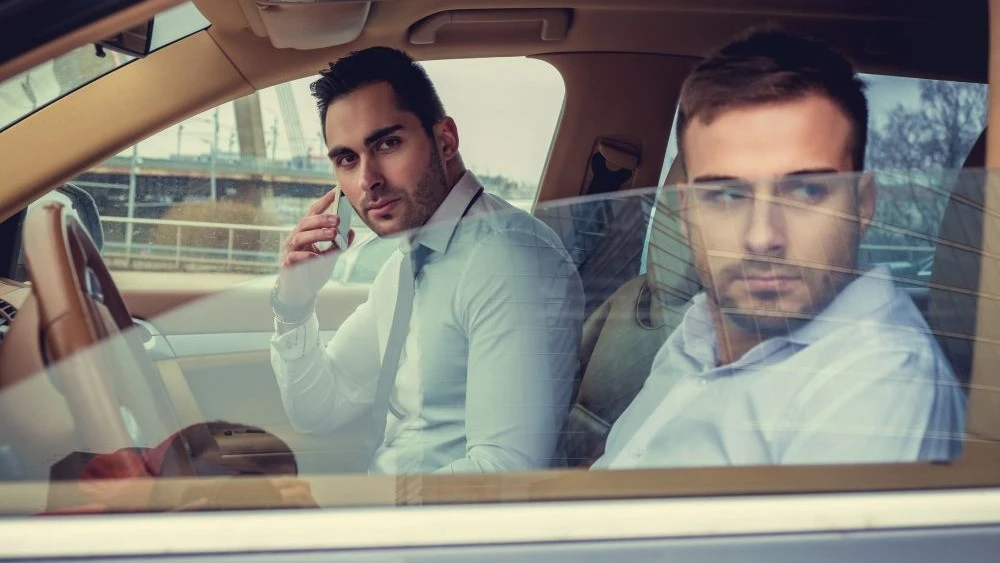
Most people involved in a car accident in Tampa Bay focus entirely on the driver who caused the crash. That makes sense. But here is something worth knowing: in Florida, the owner of the vehicle can also be held legally responsible, even if they were not in the car and even if they were not negligent in lending the car to the other driver.
This is not a technicality. It is a legal doctrine called “vicarious liability” which is a long standing doctrine protecting accident victims for over a century, and it can significantly change what you are able to recover.
So, what exactly is vicarious liability?
Vicarious liability is the legal concept that one person can be responsible for the actions of another. You generally need to show three elements which are:
- A recognized legal relationship such as principal-agent, parent-child, vehicle owner-driver, and even employer-employee;
- The primary actor engages in negligent behavior that causes harm to someone;
- And the negligence occurred while the primary actor was performing tasks, duties, etc. within the scope of the recognized legal relationship.
The legal doctrine of vicarious liability is broad in nature and functions like a spiderweb or bridge connecting other legal doctrines such as respondeat superior and the dangerous instrumentality doctrine.
How Does the Dangerous Instrumentality Doctrine Impact Car Accident Liability in Tampa Bay?
In Florida, we are a modified comparative fault state which means each person is only liable for their proportional share of negligence. However, in the context of Florida car accidents, the owner of a vehicle will be held to a strict liability standard for the permissive driver’s negligent actions under Florida’s dangerous instrumentality doctrine. That means the victim in a car accident case can pursue the judgment for damages against the driver, the owner, or both. The policy reasons behind the dangerous instrumentality doctrine are premised upon the theory that the person that originates the danger by entrusting the automobile to another is in the best position to make sure there are adequate resources for which to pay for its negligent operation See Kraemer v. Gen. Motors Acceptance Corp., 572 So. 2d 1363, 1365 (Fla. 1990)
You should also know that Florida’s dangerous instrumentality doctrine originated via common law and was adopted in Florida around 1920 See Southern Cotton Oil Co. v. Anderson, 80 Fla. 441, 86 So. 629 (Fla. 1920); See Also Emerson v. Lambert, 374 So.3d 756, 757 (Fla. 2023). And it means that owners of inherently dangerous items (like cars) will be strictly liable for harm caused by that item – in this case cars – with few exceptions. For example, your friend could be known as the safest driver in the entire world, so how could you be negligent for lending him/her your vehicle? Well, under the dangerous instrumentality doctrine if he or she is driving in Tampa Bay on Interstate 75 merging onto Tampa Bay’s Veterans Expressway (SR 589) and causes an accident, you (the owner of the vehicle) and your friend are both liable.
Here are the most common real-world situations:
- You lent your car to a friend or family member. They get into a crash. Under Florida law, you as the owner will be civilly liable alongside the driver.
- An employee was driving a company vehicle. If they cause a crash while working in Tampa Bay, the employer can be held responsible. This is where vicarious liability overlaps with employer liability, which we cover in our guide on respondeat superior.
- A teenager used the family car. Parents often assume their child’s negligence falls only on the child. In Florida, if the car belongs to you, then you are strictly liable for your child’s actions as a permissive driver.
Are there any limits on what a vehicle owner can owe?
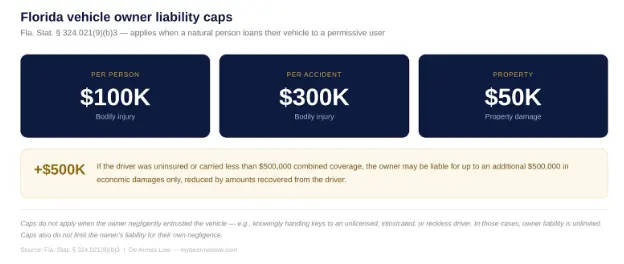
Yes. While Florida’s dangerous instrumentality doctrine is derived from common law, the Florida legislature has codified it via Florida Statute 324.021(9)(b)3 which places caps on how much a non-driving owner can be required to pay: 100,000 per injured person, 300,000 per accident for bodily injury, and 50,000 for property damage.
Those limits matter, but they have an important exception. If the owner was negligent in entrusting the vehicle, meaning they gave the keys to someone they knew was unlicensed, intoxicated, or a dangerous driver, the caps may not apply and the owner could face much greater exposure. Further, if the negligent driver is uninsured or has combined property damage and bodily injury limits below $500,000, the owner can be liable for an additional $500,000 dollars.
What if someone took the car without permission?
Ownership alone does not automatically equal liability. If someone took your vehicle without your consent, you are generally not responsible for what they do with it. The owner’s liability under the dangerous instrumentality doctrine hinges on whether they allowed the other person to drive.
Tip: If you have teenagers at home who are getting close to driving age, it is worth talking to both your attorney and your insurance agent about how titling and coverage decisions could affect your family’s liability exposure.
Why does this matter if you were injured?
Because it can affect your underinsured motorist claim (if applicable), and also opens up more paths to compensation. Instead of being limited to what the driver’s own insurance can cover, you may also have a claim against:
- The vehicle owner’s personal insurance policy
- The vehicle owner’s personal assets in serious cases
- A commercial insurance policy if the vehicle was employer-owned
In accidents involving serious injuries, this distinction is often the difference between a partial recovery and a full one.
Frequently asked questions
- Can I sue the car owner if they were not in the vehicle? Yes. Under the theory of “vicarious liability,” and its interplay with Florida’s dangerous instrumentality doctrine, claims against owners can proceed even when they were not present, as long as the driver had permission to use the car.
- Does this apply to rental cars? Rental companies have special protection under a federal law called the Graves Amendment, which generally shields them from strict liability. However, they can still be liable if they rented a vehicle they knew was unsafe.
- What if the owner and driver are the same person? Then there is no separation of liability. The driver and owner are one and the same, and standard negligence rules apply.
- Does regular auto insurance cover vicarious liability claims? Yes.
- What if I was partly at fault in the crash? Florida follows a modified comparative negligence rule. If you are found more than 50% at fault, you cannot recover. Below 50%, your compensation is reduced proportionally by your share of fault.
Injured in a crash in Tampa Bay, Orlando, or anywhere in Central Florida? Multiple parties may owe you. Contact us today. Tampa: 813-680-7777 | Orlando: 407-362-7777 | Pinellas: 727-260-7777. No fee unless we win.
Disclaimer: The information contained herein is for informational purposes only, does not create an attorney-client relationship, and is not intended, and should not be relied upon, as legal advice. We strive to ensure accuracy but some information may become outdated or no longer applicable. Legal outcomes vary based on individual circumstances. Past results do not guarantee the same or similar outcomes.
Share This Post

About The Author: Jonathan De Armas, Esq
Jonathan De Armas, Esq. is the founder of De Armas Law, serving families across Tampa and Orlando. A former public defender and insurance defense attorney, he now fights for injury victims with experience, integrity, and personal attention.


 Website by