


Respondeat Superior in Tampa, Florida: When Is a Company Liable for an Employee’s Actions?
An Uber driver hits your car. A FedEx driver runs a red light. A hotel security guard injures a guest. In Florida, the company may be just as liable as the person who actually caused the harm.

So what is respondeat superior?
Respondeat superior is a Latin phrase that means “let the master answer.” It is derived from the doctrine of vicarious liability and common law, and it’s used to hold employers liable for the harmful actions of their employees, as long as those actions happened while the employee was in the course and scope of their employment. To maintain a cause of action under Respondeat Superior, you must show the following elements:
- Employer-employee relationship
- The employee was negligent
- Within the scope of his/her employment
- Causation and actual harm.
The policy reasons why Respondeat Superior exists are that employers benefit from the work their employees do, they control how that work gets done, and they are in the best position to prevent harm through implementing safe policies and procedures, proper hiring protocol, training, and supervision. As a matter of good sense and public policy, we want employers to take their hiring standards, training, and supervision duties seriously, and if they are negligent in doing so, the law will hold the employer accountable through the legal doctrine of respondeat superior.
Here is a situation that plays out regularly in Tampa Bay: a delivery driver on I-4 is merging onto Tampa Bay’s I-275 and causes a car accident; a negligent hotel employee forgets to put down a wet floor sign; an Uber driver causes an accident on the Courtney Campbell Causeway (SR 60). The injured victim may assume their only option is to go after the negligent employee, but the employee usually does not have the insurance coverage to fully compensate for the damage caused by their negligence. Under the doctrine of respondeat superior, the victim of the employee’s negligence can often hold the employer or business owner liable.
How would a court in Tampa Bay decide if the employer is liable under respondeat superior?
There are two core questions courts look at.
#1. Was the negligent person an employee?
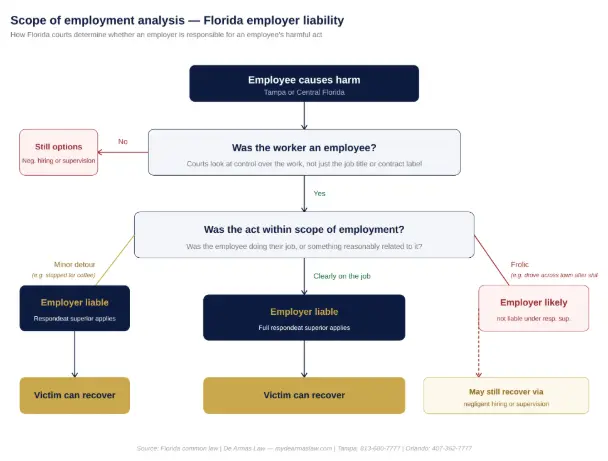
This sounds simple. It is not. Many companies classify workers as independent contractors for a myriad of reasons, and one of those reasons is to avoid liability. How? Well, under the law, an independent contractor is generally not considered an employee. If the worker is negligent and is not an employee, the employer will likely not be responsible or liable for the damages under the theory of respondeat superior. However, actions speak louder than words – and a label or title is not the controlling factor as it pertains to the definition of employee or non-employee.
Instead, a Hillsborough Court in Tampa Bay would look at the actual working relationship between the employer and employee. For example, if the employer retains the right to dictate how the work is done, does the worker follow company schedules, rules, and procedures? Did the company provide tools or a vehicle?
If the answer to most of those is yes, a Tampa Bay court may treat the worker as an employee regardless of what the contract or job title says. It’s kind of like the old saying – “if it walks like a duck, talks like a duck ….” Well, then, it’s probably a duck. This analysis of employee vs. non-employee is especially important for rideshare and delivery drivers, and for healthcare workers technically labeled as independent contractors but functioning entirely within a hospital system.
#2. Was the employee acting in the course and scope of their employment?
The harm has to have occurred while the employee was working, or doing authorized tasks connected to their job, serving their employer’s interest. This is commonly known as working in the “course and scope of their employment.” And there are times when the “scope and course” can become murky. Tampa Bay courts generally measure the situation as follows:
- Detour. Was it a minor personal deviation, like stopping for coffee during a delivery run? Courts will often still hold the employer responsible.
- Frolic. A major departure from work entirely, like food shopping for your household while you were supposed to be on a delivery run. In a “frolic,” the employer generally is not liable under respondeat superior for an employee’s negligence, though negligent hiring or supervision claims may still apply under a general theory of negligence.
That said, do not assume the employer gets off the hook just because they claim their employee was “off-duty” or the employee was an “independent contractor.”
What if the “employee” was an “independent contractor” and the respondeat superior doctrine doesn’t apply?
You may still have a claim against the employer even when the respondeat superior argument does not fully hold under general theories of negligence, such as negligent hiring.
An employer can be held liable for an independent contractor or anyone they retain on their company’s behalf if they fail to use reasonable care in the hiring process. As a result of not using reasonable care in the hiring process, an unfit person with dangerous tendencies is hired and thereafter causes an injury. The employer could be found liable in a Tampa Court for negligent hiring practices under a general theory of negligence.
For example, a delivery company that hires a driver with multiple DUI convictions, a hospital that credentials a physician without verifying their license, or a property management company that puts a security guard with a violent history in front of guests: in each case, the harm was foreseeable, and the company had the opportunity to prevent it.
The above general theories of negligence are powerful tools available to injury victims in Florida, and they can apply even when the employee was technically off-duty or acting outside the scope of their job.
What about negligent supervision and negligent retention?
- Negligent supervision. An employer who fails to monitor employee conduct, enforce safety policies, or intervene when problems become obvious can be held liable independent of what the employee was doing at the time of the incident.
- Negligent retention. If an employer received credible warnings about a dangerous employee and chose to keep them on anyway, they can be held responsible when that employee eventually causes harm.
Tip: Negligent hiring, negligent supervision, and negligent retention are general negligence claims, independent from respondeat superior. They focus on what the employer knew and failed to do, which means even a successful frolic defense does not automatically protect the company from liability.
Where do we use Respondent Superior the most in Florida?
-
Rideshare: Uber and Lyft
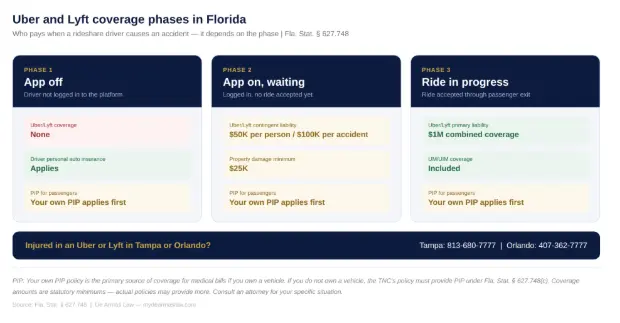
Uber and Lyft classify drivers as independent contractors, but remember, courts look at the employee-employer relationship, not just a job title or classification. What also matters is the phase of the trip at the moment of the crash, which dictates coverage. Phase also determines whether Florida PIP benefits apply. Passengers in rideshare vehicles are generally not entitled to PIP the same way they would be in a privately owned vehicle.
-
Trucking and commercial vehicles
When a truck driver causes a crash during a delivery run, the trucking company is almost always in the picture. Federal safety regulations, large commercial policies, multiple potential defendants, and Florida’s dangerous instrumentality doctrine make these cases more complex and often more valuable than standard auto claims.
-
Delivery drivers
FedEx, Amazon Flex, Uber Eats, pizza delivery: the contractor vs. employee analysis applies to all of them. Courts look at how much control the company actually exercised over the driver’s routes, schedule, and methods.
-
Hotels, property management, and the service industry
When a hotel employee, maintenance worker, or security guard injures someone on duty, the property or management company can face liability under both respondeat superior and premises liability. Under HB 837, insurance carriers can now place an intentional tortfeasor on the verdict form in negligent security cases, which can affect how fault gets divided.
-
Medical negligence and hospitals
Many physicians are technically classified as independent contractors, but if the hospital controls their schedule, setting, and protocols, a court may still hold the hospital responsible. For staff who are clearly employees, nurses, technicians, or orderlies, respondeat superior applies more directly.
Frequently asked questions
- What is negligent hiring exactly? It is a claim against an employer for being negligent, whether bringing on someone with a known dangerous history, or simply failing to follow proper industry standards. The focus is on what the employer knew before hiring, not what the employee did on a specific day. It is an independent cause of action from the doctrine of respondent superior.
- Can I sue the company if the employee was off the clock? It depends. If their actions were still connected to their job duties, a claim may hold. If not, negligent hiring or supervision may still apply.
- What if the company says the worker was an independent contractor? Florida courts look at the actual working relationship, not just the label in the contract.
- What is the difference between negligent hiring and respondeat superior? Respondeat superior is about the employer being liable for the employee’s negligence on the job. Negligent hiring is about the employer’s negligence directly as to why they hired that person in the first place. Both can apply to the same case.
- Does HB 837 affect employer liability cases? Yes. The modified comparative fault rules mean you cannot recover if found more than 50% at fault. In negligent security cases, the new verdict form rules can also affect how damages are split.
- What if I were hurt by an Uber or Lyft driver? Coverage depends on which phase of the trip the driver was in. The platform’s insurance is layered, and determining which policy applies is one of the first things we look at. You can be sure that both Uber and Lyft can be successfully sued under a theory of Respondeat Superior.
- How long do I have to file in Florida? For most personal injury claims, two years from the date of the incident. Evidence disappears, and witnesses forget. Do not wait.
- What can I recover? Medical expenses, past and future, lost wages, earning capacity, pain and suffering, emotional distress, and property damage. Employers carry larger policies than individuals, which is why bringing the employer into the case often leads to greater recovery.
Hurt by someone on the job in Tampa, Orlando, or anywhere in Central Florida? Contact De Armas Law. Tampa: 813-680-7777 | Orlando: 407-362-7777 | Pinellas: 727-260-7777. No fee unless we win.
Disclaimer: The information contained herein is for informational purposes only, does not create an attorney-client relationship, and is not intended, and should not be relied upon, as legal advice. We strive to ensure accuracy but some information may become outdated or no longer applicable. Legal outcomes vary based on individual circumstances. Past results do not guarantee the same or similar outcomes.
Share This Post
About The Author: Jonathan De Armas, Esq
Jonathan De Armas, Esq. is the founder of De Armas Law, serving families across Tampa and Orlando. A former public defender and insurance defense attorney, he now fights for injury victims with experience, integrity, and personal attention.


 Website by